

Tebis V4.1 R7 full cracked licesne
170 $
Tebis 4.1 Release 7 for even better collision checking and less re-machining
Your benefits at a glance:
- Solid technology: Now easily select faces
- Tool simulation: Check any geometries with just a few mouse clicks across NCJobs
- Prevent collisions during CAM calculation: Now totally account for the machine head in all strategies
- 3-axis finishing: High-quality milling results even faster
- 5-axis simultaneous roughing of pockets and surfaces: Reduce machine run time even more, low-wear plunge movements
- Improved usability: Interactively display the contact point between milling tool and part surfaces and analyze cutting conditions at a glance
- Laser drilling: An even shorter calculation and machine run time
Description
CAD – Parametric design
Conveniently control changes with user parameters
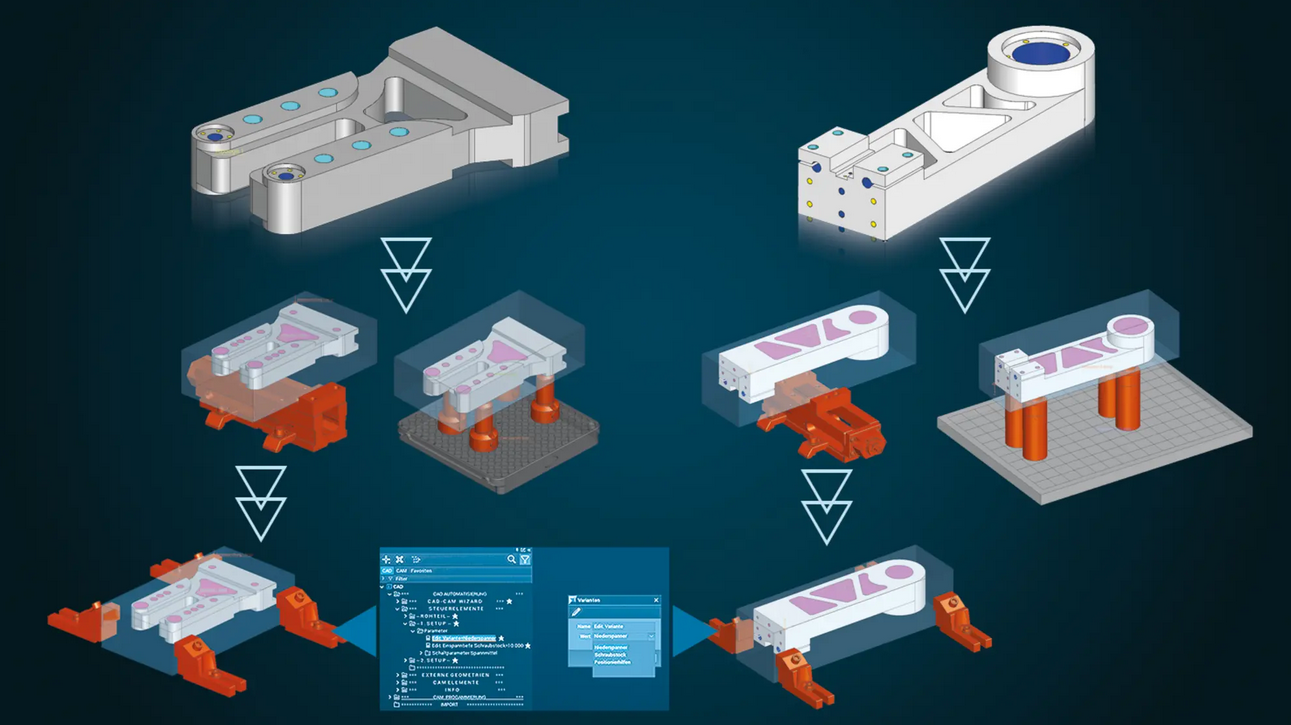
Every imported data set needs to be prepared for CAM programming in design. This usually takes many individual work steps: Bores for clamping systems must be placed, tilt axis systems defined, fill surfaces designed, blanks created, connection points for setups generated, clamping devices positioned and retract planes defined. These many individual steps can be highly automated in Tebis using parametric CAD templates. These templates can be extended as needed and can be adapted to meet customer-specific requirements. Users can still be highly flexible: Changes like selecting a different clamping system can now be controlled directly and conveniently with the user parameters in the object tree.
CAD – Active surface design
Precise results when trimming deep-drawing and bending parts
The “Create development curves” function can be used to quickly and easily determine theoretically designed trim edges for flanges on deep-drawing and bending parts. The material thickness of the component and the location of the neutral fiber are accounted for – and the result is highly precise, with no manual reworking necessary. The quality of the resulting curves corresponds to that of the original curves.
Multiple calculation modes cover different use cases.
Multiple calculation modes cover different use cases.
CAM – Automation
Shorter programming time thanks to improved NCJob technology
Your CAM programs are finished more quickly with these new features:
Take advantage of the opportunity to automatically apply interactively defined milling areas from previous NCJobs in milling.This allows you to reduce manual intervention in CAM programming and calculate entire NCJob sequences at once. CAM programming is also significantly simplified – you can easily manage combined machining operations in an end-to-end CAM template.
And you can avoid issues like superfluous calculation time by conveniently calculating multiple NCJobs simultaneously up to “Areas calculated” or “Sorting executed” status.
CAM – Drilling
Flexibly use special cutters
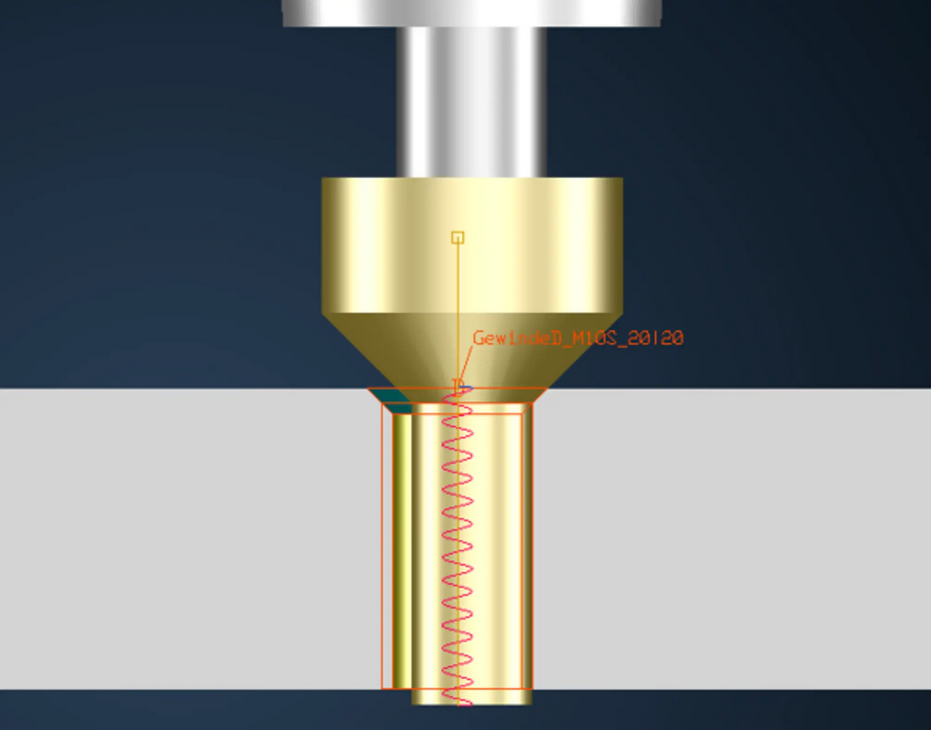
When using combined special cutters with several cutting edge areas of different diameters, only the diameter of the active cutting edge determines whether the tool is suitable for the specific machining task. This enables highly flexible use of special cutters for drill-milling and thread milling in bores and circular pockets – regardless of the diameter of the largest cutting area. The plausibility check also only accounts for the properties of the cutting area actually used.
CAM – Milling
Optimal cutting conditions for roughing rotationally symmetrical parts
A real plus for combined turning/milling operations: In addition to cylindrical parts, tapered parts such as screw conveyors can now also be machined with high efficiency. The tool first roughs the part to the maximum possible depth with a low stepover and large downfeed in a single pass. Then it machines the residual stock from bottom to top with a smaller cutting depth – precisely to the stock allowance. This procedure reduces tool wear and ensures a high material removal rate on the machine. The user can easily program the final finishing operation with a special function: Only the strategy is replaced – the system does the rest.
Safely manufacture external threads
External threads can now be quickly manufactured in just one NC program – including stud, chamfer and undercut This gives parts manufacturers even more options for programming toolpaths quickly, completely and safely in a simulation-supported CAM system.
Efficiently machine planar areas
It’s usually more cost-effective to machine the planar areas of a part after hardening with a smaller stock allowance than the non-planar areas Special tool types like large insert mills can then be used for this step. Tebis therefore offers a new function that automatically detects purely planar areas within selected part surfaces without the need to further subdivide the part.
Automatic tilt direction calculation with circle-segment cutters
This new function greatly simplifies the programming of multi-axis toolpaths for pre-finishing and finishing with circle-segment cutters, also known as “barrel cutters”. It automatically determines the best tilt direction for manufacturing the machining area completely free of collisions. The function simultaneously calculates the optimal contact point at the surface boundary to ensure the maximum possible material removal. Machining is indexed or 5-axis simultaneous: The user can independently specify the preferred variant or can leave the decision up to the system.
Continuous, automated 3-axis finishing of flank surfaces, transition areas and bottom surfaces with no offset
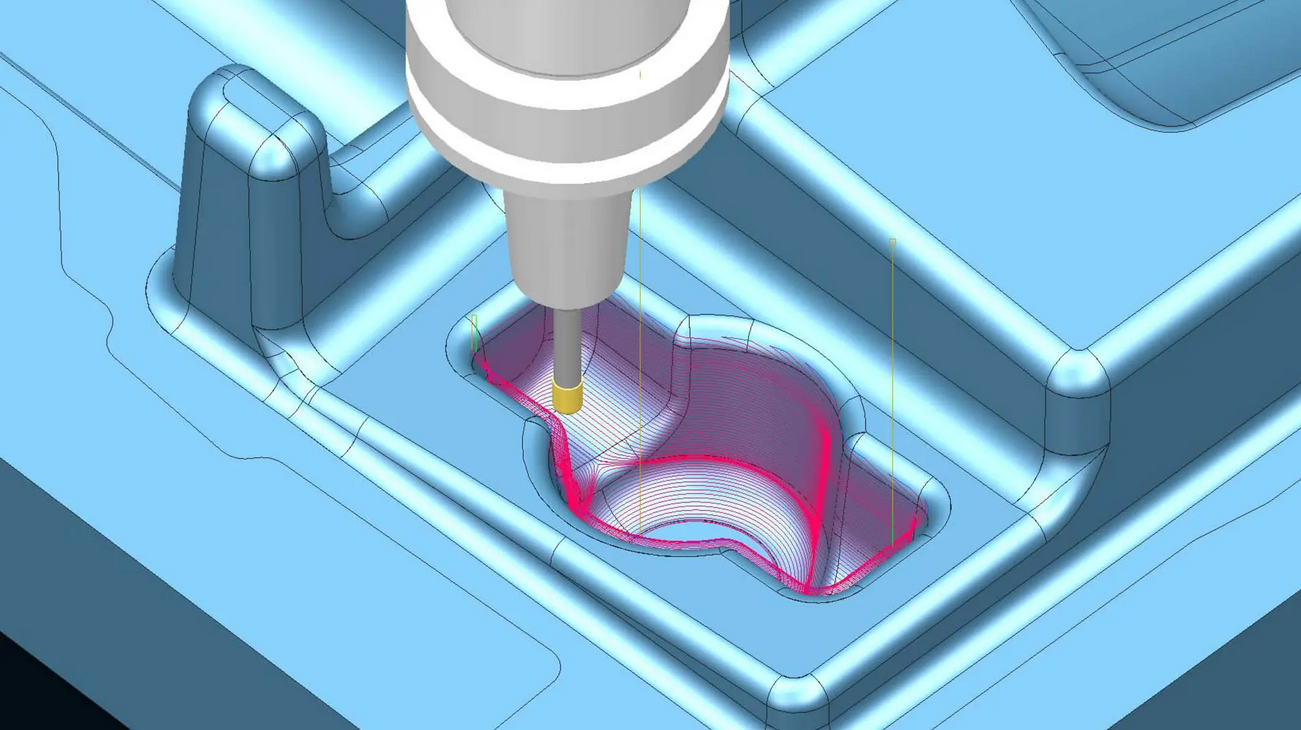
Geometries with steep flank surfaces, straight bottom surfaces and entrance and exit radii – like ribs and slots – can now be machined automatically and with a uniform step and 3-axis Z-constant machining with the “Finishing surfaces” function – without retract movements, without extra design effort and at outstanding quality.
CAM – Lathe
Turning with convenient cutting off of the part
Parts can be cut off from bar stock with a special function for automated machining on lathes or turning-milling centers. You can quickly and easily define the optimal cutting conditions for feed rate and speed on material exit. You can easily cut the part off straight or finish its contour at the same time without having to design an auxiliary geometry. You can deburr the part and turn the bar side flat during cutoff. This allows you to immediately manufacture the next part with the bar stock. The cut-off part can be transferred to the second spindle or taken up by the part gripper/catcher – with automatic control and reliable simulation.
CAM – Machine technology
Improved support for multi-channel machine tools
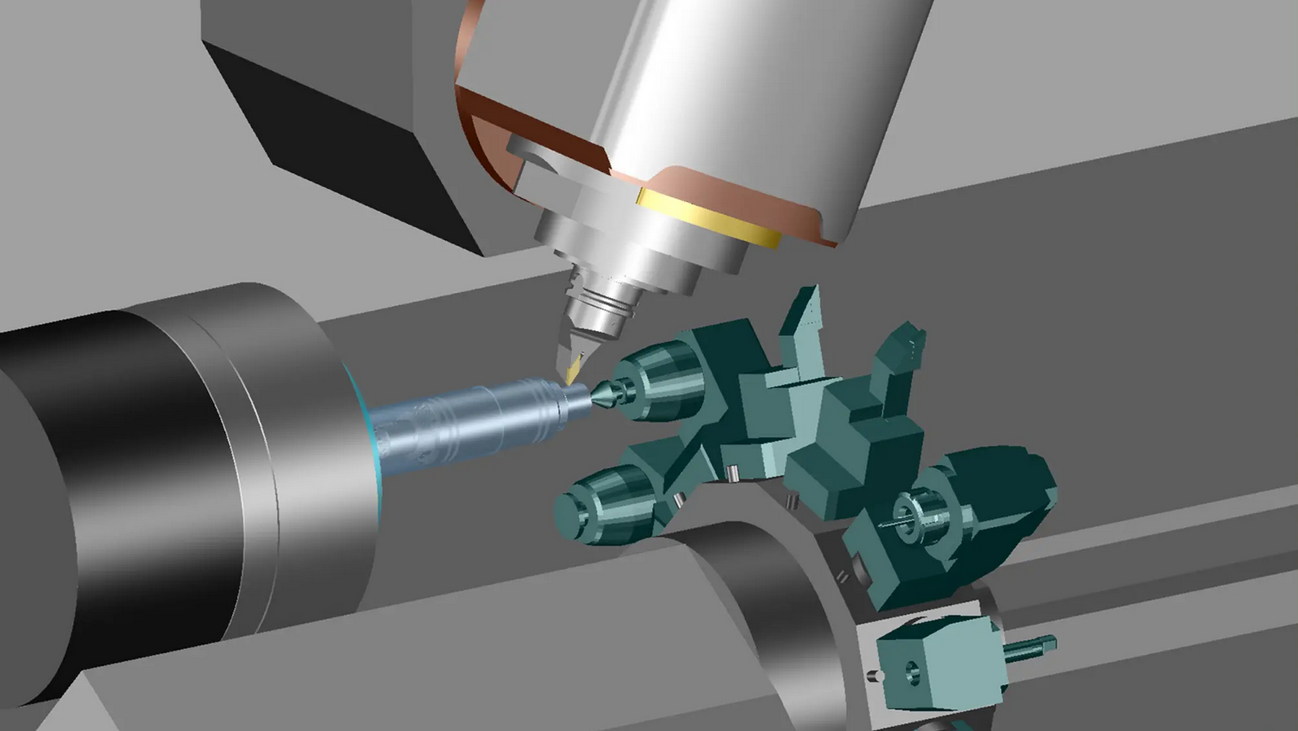
This innovation is especially advantageous for manufacturing companies that rely on combined turning/milling operations, especially if the components to be machined have a high milling fraction: Tebis can now be used to program toolpaths for sequential processing on machines with multiple tool and component holders. The individual steps – such as milling with a milling head or turret, stabilizing with a centering tip or clamping with a sub spindle – can be combined in any way. All tool and component holders are stored in the virtual Tebis process libraries: These can be interchanged quickly and flexibly in programming. As always in Tebis, all system components are fully accounted for in collision checking and simulation. Programming is as easy as can be, following Tebis’s stringent and proven programming logic. Tebis automatically generates NC code for any machines and supports all control-specific program structures, such as Gildemeister structure programs.
CAM – Job planning
Complete collision control with material removal simulation
Material removal simulation ensures safe and reliable collision control. The actual material on the model is reliably accounted for at all times during machining and is checked against both the tool and all machine components. The blank is updated in each machining step.
✅ **WooCommerce Product Description (copy/paste HTML)**
*(Tip: copy only the HTML block below into your WooCommerce “Product description” field.)*
“`html
🚀 Tebis V4.1 Release 7 (R7) – Safer CAM Programming, Smarter Collision Checking & Faster High-Quality Milling
Tebis V4.1 Release 7 (R7) is a powerful upgrade for manufacturers who demand maximum machining safety, top surface quality, and high automation in a single professional CAD/CAM environment. Release 7 focuses on what matters on the shopfloor: better collision checking (including the machine head), less re-machining, and faster, simpler programming of complex geometries.
Whether you work in mold & die, model making, production machining, or aerospace, Tebis 4.1 R7 helps you create reliable NC programs with fewer iterations, reduced risk, and consistently better results.
✨ What’s New in Tebis 4.1 R7
🧩 CAD – 3D Design: Improved Solid Technology
- Select faces as starting elements (in addition to edges) for solid design operations.
- When a face is modified, its edges automatically adapt to the updated geometry.
- More convenience with multi-selection of edges for faster modeling preparation.
🧪 CAM – Job Planning: Tool Simulation Across Multiple NCJobs
- In tool simulation across multiple programs, you can check toolpaths against different geometry types (e.g., machining surfaces and protected surfaces).
- Select starting blanks during material removal simulation to verify process planning quickly.
- Result: a faster, clearer validation workflow before moving to the next machining steps.
🛡️ CAM – Milling: Collision Avoidance That Fully Accounts for the Machine Head
Major highlight of R7: potential collisions can be detected and prevented during CAM calculation, while accounting for the precise machine head geometry. This closes safety gaps earlier in the process—before NC output—so you can program with more confidence.
- 2.5D machining: collision avoidance strategies are now fully integrated; milling areas can be automatically reduced or excluded from machining.
- 5-axis simultaneous avoidance milling: strategies are extended and Tebis can automatically determine correct pivot positions.
- Even less-experienced users can generate collision-checked NC programs efficiently.
🏁 3-Axis Finishing: Faster, Easier Equidistant Results on Complex Geometry
- Machine complex geometries with precise, constant stepover across the entire part in a single operation.
- Workflow simplified: select up to two guide curves and Tebis handles the rest automatically.
- Benefit: very high-quality surfaces with no offset, reducing or eliminating manual rework—ideal for forging dies and automotive outer surface parts.
🧠 5-Axis Simultaneous Roughing: Reduced Residual Stock & Shorter Machine Run Time
R7 introduces flexible machining modes for 5-axis roughing of pockets and surfaces depending on your manufacturing situation:
- Dynamic option: 5-axis machining normal to the surface curvature.
- Constant option: 3-axis machining parallel to surface curvature (recommended for thin-walled parts with vertical flanks and curved bottom surfaces—common in aerospace).
- Outcome: residual stock is reduced to a minimum and can often be cleared in a single operation—cutting machine time while maintaining precision.
🌀 Helix Strategy: Plunge Movements with Low Tool Wear
- In 5-axis adaptive roughing with the Helix strategy, you can influence tool direction during spiral plunge movements.
- Choose ramp movement normal or constant relative to the cutting plane depending on the job.
- The Normal option can reduce tool stresses significantly—supporting longer tool life and more stable roughing.
🎯 Better Usability: Interactive Contact Point Display
- R7 adds an interactive display of the actual contact point between the milling tool and part surfaces directly in the NCJob.
- Quickly analyze cutting conditions and verify whether the tool reaches all milling areas.
- Perfect for preventing missed areas and improving process confidence.
🔦 CAM – Laser Drilling: Faster Programming & Optimized Processing Sequence
- Automatic programming of laser drilling operations with different tilt directions is improved again in R7.
- When the NCJob starts, machining areas are sorted automatically into the optimal processing sequence.
- This can significantly shorten both calculation time (in CAD/CAM) and machine run time.
🌟 Tebis 4.1 R7 Highlights (Why You’ll Feel the Upgrade)
- ✅ More machining safety with collision avoidance that fully includes the machine head
- ✅ Less re-machining thanks to earlier, more reliable collision prevention
- ✅ Higher surface quality with faster, simplified equidistant 3-axis finishing
- ✅ Shorter cycle times via reduced residual stock and smarter roughing modes
- ✅ Lower tool wear with optimized plunge behavior in Helix roughing
- ✅ Faster verification using multi-NCJob simulation and interactive contact point analysis
- ✅ Improved laser drilling automation with optimized processing sequence
🐞 Bug Fixes & Stability Improvements (What to Expect)
Tebis delivers ongoing improvements through releases and service packs as part of its software update process. With a Tebis service contract, customers receive access to new updates and documentation, which helps keep the installation current in areas such as:
- 🧩 Interface and workflow refinements (usability improvements)
- ⚡ Performance optimizations (calculation speed, responsiveness)
- 🔁 Data transfer & interfaces (import/export and interoperability improvements)
- 🎯 Accuracy and reliability improvements across CAD/CAM functions
Note: the exact “fixed issues” list can vary by installation and the applied service pack level. For regulated production environments, always validate updates according to your internal change-control procedures.
💻 System Requirements (Official)
Minimum requirements (to install and run Tebis):
- 🪟 OS: Windows 11 (64-bit)
- 🧠 CPU: x86-64 with at least 3.00 GHz clock frequency
- 🧮 RAM: 16 GB minimum
- 🎮 GPU: Professional CAD workstation graphics (AMD Radeon Pro / NVIDIA)
- 💾 Storage: 2 GB free disk space for installation
- 🔌 Hardware: USB port (or USB sharing device for single-workstation solutions)
Hardware recommendations by workload (examples):
- 🟢 Entry level (medium CAD files up to ~1 GB): Ryzen 5 / Intel Core Ultra 5, 16 GB RAM, NVMe SSD, entry pro GPU
- 🟡 Mid level (large CAD files ~1–3 GB): Ryzen 7 / Intel Core Ultra 7, ~64 GB RAM, stronger pro GPU
- 🔴 High level (very large CAD files >3 GB): Ryzen 9 / Intel Core Ultra 9, ~128 GB RAM, high-end pro GPU
🏭 Who Should Choose Tebis V4.1 R7?
- 🔧 Mold & die manufacturers aiming to reduce manual rework and improve machining safety
- 🚗 Automotive tooling teams creating high-quality outer surfaces and complex dies
- ✈️ Aerospace machining operations working with thin-walled parts and complex pocket geometries
- 🧰 Production machining departments standardizing reliable NC programming workflows
- 🧪 CAM teams that need stronger verification, collision avoidance, and consistent surfaces
💡 Interesting Fact
Tebis 4.1 is designed as a complete parametric-associative CAD/CAM system that supports tasks in manufacturing preparation, design, and CAM programming in a single, highly automated workflow—helping teams build repeatable processes and reduce programming time.
⭐⭐⭐⭐⭐
As a developer supporting CAM automation and postprocessor workflows, Tebis V4.1 Release 7 has been one of the most reliable CAD/CAM upgrades I’ve deployed in production. The collision avoidance improvements (including machine head awareness) and the stronger 5-axis milling controls noticeably reduce risky toolpath iterations, while multi-NCJob simulation makes validation faster and more consistent across teams. In daily use, performance feels smoother on large assemblies, and the overall stability helps keep programmers focused on machining strategy rather than troubleshooting.
What stands out in Tebis 4.1 R7 is how well the new finishing and roughing enhancements translate into real shopfloor value: cleaner equidistant 3-axis finishing on complex surfaces, better residual stock control in 5-axis roughing, and practical usability tools like contact point visualization. For anyone running high-precision machining (mold & die, automotive, aerospace), Tebis V4.1 R7 is a strong step forward for safer toolpaths, higher surface quality, and repeatable, standardized programming.
Related products
-
Sale!

Intergraph TANK NEW cracked version
Original price was: 180 $.150 $Current price is: 150 $. Add to cart Quick View -
Nikon CMM-Manager 3.5 cracked
180 $ Add to cart Quick View -

PREMIER+ ULTRA full cracked version
150 $ Add to cart Quick View -
Sale!

ZEISS CALIGO 4.4.1 cracked version
Original price was: 200 $.140 $Current price is: 140 $. Add to cart Quick View -
Sale!
DRAWings 8 Pro cracked version
Original price was: 1,800 $.140 $Current price is: 140 $. Add to cart Quick View -
Tebis V4.0 R4 full cracked version
150 $ Add to cart Quick View -

Intergraph CAESAR II v11 cracked version
120 $ Add to cart Quick View -
Sale!

Intergraph CADWorx 2017 R1 cracked version
Original price was: 180 $.150 $Current price is: 150 $. Add to cart Quick View -
Sale!

RESISTANCE & PROPULSION SUITE
Original price was: 3,500 $.150 $Current price is: 150 $. Add to cart Quick View -
Sale!

CamLink cracked version
Original price was: 200 $.155 $Current price is: 155 $. Add to cart Quick View