

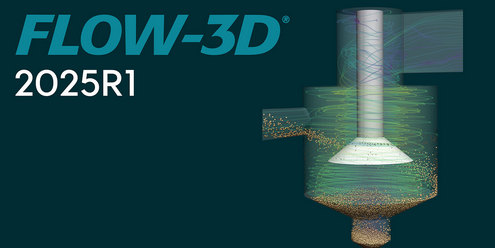
FLOW-3D 2025R1 full cracked version released
180 $
FLOW-3D 2025R1 is a cutting-edge CFD software suite offering advanced simulation tools for fluid dynamics, casting, welding, additive manufacturing, and hydraulics. Now featuring high-performance computing, DEM modeling, and enhanced UI for faster, more accurate results…
Description
FLOW-3D 2025R1 – The Next Generation of CFD Software for Advanced Simulation and Engineering Innovation
FLOW-3D 2025R1 is the latest major release of the industry-leading computational fluid dynamics (CFD) software developed by Flow Science. Designed for engineers, researchers, and designers in fluid mechanics, casting, welding, additive manufacturing, and civil and environmental engineering, FLOW-3D 2025R1 delivers powerful new features, performance upgrades, and user interface enhancements that dramatically improve simulation accuracy, speed, and workflow efficiency.
This release introduces key innovations, including a fully integrated Discrete Element Method (DEM) solver, extended high-performance computing (HPC) capabilities, new process-specific simulation templates, and improved automation for multiphysics modeling. Whether you’re optimizing hydraulic structures, simulating metal casting and welding processes, or advancing additive manufacturing methods, FLOW-3D 2025R1 empowers you to simulate complex physics with unparalleled detail and reliability.
🚀 Key New Features in FLOW-3D 2025R1
🔷 Discrete Element Method (DEM) Integration
One of the standout features of 2025R1 is the addition of a fully integrated DEM solver, enabling simulation of particulate flows and granular interactions. This includes modeling of particle-particle collisions, friction, drag forces, and interaction with fluids, making it ideal for applications such as sediment transport, slurry mixing, bulk material handling, erosion, and rock stability analysis.
✅ DEM is available across multiple FLOW-3D products, including HYDRO and CAST, and requires an additional license.
🔷 High-Performance Computing (HPC) Scalability
FLOW-3D 2025R1 now supports enhanced scalability on HPC systems, delivering up to 9x faster simulation runtimes on multi-core clusters. Parallel processing improvements ensure that large-scale industrial simulations are completed faster and more efficiently, without compromising accuracy.
🔷 FLOW-3D HYDRO 2025R1 Enhancements
-
New DEM capabilities for riprap stability and sediment simulation.
-
Improved mesh generation for complex geometries.
-
Enhanced support for multi-physics hydraulic structures including fishways, gates, culverts, and dams.
🔷 FLOW-3D CAST 2025R1 Upgrades
-
Revised porosity modeling and new EXODUS II output format for advanced shrinkage analysis.
-
Enhanced shot sleeve model with thermal behavior of solidified metal.
-
More accurate valve controls that help predict defects and gas entrapment zones.
🔷 FLOW-3D WELD 2025R1 Enhancements
-
Integrated UI combining FLOW-3D and FLOW-3D WELD tools for a smoother setup.
-
New simulation templates for laser welding, hybrid welding, and arc welding processes.
-
Improved restart workflows for process optimization and DOE studies.
-
Better prediction of fusion zones, heat-affected zones, and microstructure evolution.
🔷 FLOW-3D AM 2025R1 for Additive Manufacturing
-
New pre-configured templates for laser melting, powder spreading, and particle-tracking.
-
Enhanced accuracy for melt pool dynamics and residual stress predictions.
-
Integration with FLOW-3D’s particle models for simulating powder behavior during fusion.
🔷 FLOW-3D (x) 2025R1 – Automation and Optimization
-
New workflow nodes for AM and WELD simulations.
-
Ability to replace input files and reuse workflows.
-
Improved user interface to view node configurations and monitor live workflows.
-
Ideal for engineers conducting design exploration, optimization, and digital twin simulations.
🛠️ Bug Fixes and Stability Improvements
FLOW-3D 2025R1 includes numerous under-the-hood fixes that improve the software’s reliability and accuracy:
-
Fixed incorrect pressure extrapolation for fluid-solid interfaces in coupled simulations.
-
Resolved memory usage spikes during long simulations and batch runs.
-
Improved convergence behavior in heat transfer and free surface flow models.
-
GUI responsiveness improved during large mesh generation and restart loading.
-
Increased reliability in file saving and simulation recovery after interruptions.
💻 System Requirements for FLOW-3D 2025R1
Operating Systems
-
Windows 10/11 (64-bit)
-
Linux (RHEL, CentOS, Ubuntu – 64-bit distributions)
Processor
-
Multi-core CPU (Intel Xeon, AMD Ryzen/EPYC preferred)
-
AVX2 instruction set support required
Memory (RAM)
-
Minimum: 16 GB
-
Recommended: 32–64 GB for large models
Graphics Card (GPU)
-
OpenGL-compatible graphics card (NVIDIA or AMD) for GUI rendering
-
Not required for solver operations
Storage
-
SSD with at least 100 GB of available disk space
-
Additional space recommended for result files
Networking
-
Ethernet or internet access for license management
-
Required for distributed computing and cluster support
🌍 Applications and Industries
FLOW-3D 2025R1 serves professionals in diverse industries, including:
-
Civil & Environmental Engineering: dam safety, spillways, sedimentation, stormwater
-
Metal Casting & Manufacturing: die casting, sand casting, mold filling, solidification
-
Welding & Joining: laser welding, arc welding, hybrid welding, heat-affected zone prediction
-
Additive Manufacturing: powder bed fusion, melt pool dynamics, laser-material interaction
-
Energy & Aerospace: coolant flow, multiphase flow, thermal management
📈 Why Choose FLOW-3D 2025R1?
-
Unmatched accuracy for free surface flow, multiphase flow, and thermal-fluid interactions
-
Easy-to-use interface with powerful automation and scripting tools
-
Continuous updates, industry support, and training resources
-
Scalable performance from desktop to HPC clusters
-
Trusted by industry leaders and researchers worldwide
Related products
-

Converge Studio 2025 version 4.1.2 full cracked release
160 $ Add to cart Quick View -
FLOW-3D AM 2025R1 full cracked version released
180 $ Add to cart Quick View -

3D_Evolution 4.2 full cracked license
220 $ Add to cart Quick View -
FLOW-3D WELD 2025R1 full cracked version released
180 $ Add to cart Quick View -

MSC Adams 2024 full cracked version
160 $ Add to cart Quick View -

AxSTREAM 3.9.13 full cracked software suite
150 $ Add to cart Quick View -

Moldex3D 2025 R1
160 $ Add to cart Quick View -
HYBER cracked license software
150 $ Add to cart Quick View -

Primtech 16 cracked license software
150 $ Add to cart Quick View -

Stampack Xpress 2023.0 full cracked license
170 $ Add to cart Quick View