




Schlumberger PIPESIM 2026.1
140 $
Schlumberger PIPESIM 2026.1 – Advanced Multiphase Flow & Wellbore Simulation Software
This industry-leading multiphase flow and wellbore simulation platform designed for oil and gas production optimization. With enhanced modeling accuracy, intuitive interfaces, and fast performance, PIPESIM 2026.1 delivers comprehensive reservoir, pipeline, and flow assurance analysis for production engineers. Drive better field development decisions with robust steady-state and transient simulation, support for complex fluid behaviors, and seamless integration with industry workflows. Ideal for upstream energy operations seeking real-time insights, predictive analytics, and optimized production strategies…
Description
Schlumberger PIPESIM 2026.1 – Advanced Multiphase Flow, Wellbore & Production System Simulation Software
Schlumberger PIPESIM 2026.1 represents the latest evolution of the industry-standard steady-state multiphase flow simulation software for oil, gas, and energy production systems. Trusted globally by production engineers, flow assurance specialists, and asset teams, PIPESIM enables accurate modeling, optimization, and performance forecasting of wellbores, pipelines, risers, surface facilities, and complete production networks.
Built on decades of validated physics and field-proven correlations, PIPESIM 2026.1 delivers enhanced calibration workflows, improved thermodynamics, expanded automation capabilities, and higher simulation reliability—making it an essential tool for modern upstream and integrated energy projects.
What’s New in PIPESIM 2026.1
The 2026.1 release introduces powerful new functions and usability enhancements designed to improve prediction accuracy, reduce engineering uncertainty, and accelerate decision-making across the full production lifecycle.
Advanced Multi-Parameter Well Calibration
PIPESIM 2026.1 introduces a 10-dimensional multi-test well calibration workflow, allowing engineers to simultaneously calibrate multiple parameters against measured well test data. This includes friction factors, holdup multipliers, heat-transfer coefficients, reservoir pressure and temperature, and inflow performance relationships (IPR).
This capability significantly improves history matching and delivers higher confidence in future production forecasts.
Expanded Sensitivity & Optimization Workflows
Well and system sensitivity analysis has been enhanced to support up to five simultaneous variables, automatically generating structured parametric matrices. Engineers can now rapidly evaluate operating envelopes, identify bottlenecks, and optimize choke settings, lift parameters, and network constraints without manual scenario management.
Updated Multiphase Flow Correlations
PIPESIM 2026.1 incorporates the latest Olgas-S multiphase flow model, including the high-definition (HD) correlation set. These correlations are based on extensive experimental databases and field validation, improving prediction accuracy for pressure drop, liquid holdup, and flow regime behavior across a wide range of operating conditions.
Improved Thermal Modeling for Gas Lift & Counter-Flow Systems
Thermal modeling has been enhanced to better represent counter-flow heat exchange between produced fluids and injected gas lift streams. Engineers can now apply corrections at the wellhead or along tubing depth, resulting in more realistic temperature profiles and better lift system design.
Network Enhancements & Operational Constraints
PIPESIM 2026.1 introduces branch-level rate constraints within production networks. The solver automatically meets these constraints through choke adjustment during network calculations, enabling more realistic operational modeling of gathering systems and facilities.
Enhanced Automation & Python Integration
Modern engineering workflows demand automation, and PIPESIM 2026.1 significantly expands its PythonToolkit capabilities:
-
Access to detailed spot-report results, including fluid properties, composition, slugging indicators, pigging data, and heat-transfer metrics
-
Support for user-defined environmental and metocean inputs
-
Enhanced modeling of multiphase booster systems, including recirculating flow configurations
-
Updated embedded Python 3.13 environment for faster execution, improved compatibility, and long-term scripting support
These enhancements make PIPESIM 2026.1 ideal for digital workflows, batch simulations, optimization loops, and integration with enterprise engineering platforms.
Thermodynamics & Fluid Characterization Improvements
PIPESIM 2026.1 ships with Multiflash 7.6 as the default thermodynamic engine. This provides improved PVT characterization, phase behavior prediction, and compositional modeling across a wide range of fluids, including volatile oils, gas condensates, and complex mixtures.
Accurate thermodynamics directly improve flow prediction, heat-transfer calculations, and system reliability.
Key Benefits of Schlumberger PIPESIM 2026.1
-
Accurate steady-state multiphase flow simulation from reservoir to export
-
Comprehensive modeling of wells, pipelines, risers, separators, chokes, pumps, and compressors
-
Advanced flow assurance analysis, including temperature, pressure, and phase behavior
-
Improved history matching and calibration for field-validated predictions
-
Seamless network modeling for brownfield and greenfield developments
-
High-performance solvers for large, complex production systems
-
Automation-ready platform with Python scripting support
System Requirements (Typical)
While exact requirements should always be verified in official installation documentation, typical system requirements for PIPESIM 2026.1 include:
-
Operating System: Windows 10 or Windows 11 (64-bit)
-
Processor: Multi-core Intel or AMD CPU
-
Memory (RAM): Minimum 8 GB (16–32 GB recommended for large models)
-
Storage: Several GB of free disk space for installation and project files
-
Graphics: GPU with OpenGL support for GIS and canvas visualization
Stability, Bug Fixes & Quality Improvements
PIPESIM 2026.1 continues Schlumberger’s focus on software stability, numerical robustness, and performance optimization. The release builds upon fixes and refinements introduced in the PIPESIM 2025.x series, addressing solver consistency, reporting accuracy, sensitivity workflows, and user interface responsiveness.
These improvements ensure reliable results for mission-critical engineering and operational decisions.
Interesting Facts About PIPESIM
-
PIPESIM is Schlumberger’s flagship steady-state multiphase flow simulator, widely used alongside OLGA for transient analysis
-
It supports GIS-based spatial modeling, enabling engineers to visualize production systems geographically
-
The software is used globally for field development planning, production optimization, flow assurance studies, and debottlenecking projects
-
PIPESIM models are often integrated into digital oilfield and production surveillance workflows
Why Choose Schlumberger PIPESIM 2026.1
If you require a proven, industry-accepted solution for multiphase flow modeling, well performance analysis, and production system optimization, Schlumberger PIPESIM 2026.1 delivers the accuracy, scalability, and automation needed to support high-value engineering decisions across the entire asset lifecycle.
★★★★★ 5/5
Real user review :
As a developer and production systems engineer, I use Schlumberger PIPESIM 2026.1 regularly for steady-state multiphase flow and production system simulation, and it performs exceptionally well. The software delivers accurate wellbore, pipeline, and network modeling, with noticeable improvements in calibration, flow correlations, and overall stability.
The enhanced sensitivity analysis and Python automation capabilities significantly improve productivity and make PIPESIM ideal for modern, data-driven engineering workflows. Solver performance is robust, results are reliable, and the interface remains efficient even for complex models.
Overall, PIPESIM 2026.1 is a powerful, reliable, and industry-standard multiphase flow simulation tool that I highly recommend for professional oil and gas engineering applications.
Related products
-
Schlumberger PIPESIM 2024.1 cracked release
120 $ Add to cart Quick View -

Schlumberger ECLIPSE 2026.1
190 $ Add to cart Quick View -
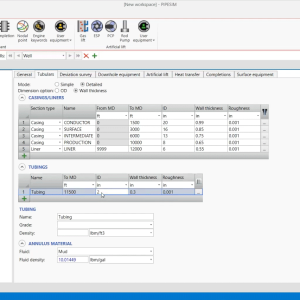
Schlumberger PIPESIM 2025.2
130 $ Add to cart Quick View -

CMG Suite 2026.20 – Advanced Reservoir Simulation Engineering Software Suite
160 $ Add to cart Quick View -

Schlumberger Techlog 2024.7
170 $ Add to cart Quick View -

Petrel and Studio 2022.4 x64 with Plugins fully cracked version
160 $ Add to cart Quick View -
Schlumberger PIPESIM 2023.1 cracked release
110 $ Add to cart Quick View -

Schlumberger PetroMod 2026.1
180 $ Add to cart Quick View -

Schlumberger OLGA 2025.1 full cracked license release
160 $ Add to cart Quick View -

RokDoc 2026.1.0 (build 180)
170 $ Add to cart Quick View